Go confidently in the direction of your dreams.
Live the life you've imagined. Henry David Thoreau

Slideshows and Photos

SLIDESHOWS LOST TO ICLOUD

SADLY, ON JUNE 30 ALL THE LINKS TO MY SLIDESHOWS WILL DISAPPEAR WHEN APPLE DISCONTINUES "MY GALLERY" AS PART OF THEIR CHANGE TO ICLOUD.

I AM ALSO PREPARING AND PACKING FOR MY PERSONAL MOVE. ONCE I AM SETTLED IN A FEW WEEKS, I WILL START TO POST AGAIN AND LOOK FOR A NEW INTERESTING WAY TO SHARE MY PHOTOS THROUGH MY BLOG.

THANK YOU FOR YOUR INTEREST IN MY TRAVELS. I WILL FIX THINGS AS SOON AS I CAN.

Saturday, January 15, 2011

Donji Milanovac, Serbia and the Iron Gates

Using my wonderful computer "time machine,"  I am now back on the Danube River on my Uniworld Riverboat Cruise in July 2010. If you want to enjoy the beginning of the trip, click on Danube Cruise on the sidebar for the earlier posts.

The Iron Gates is probably the most beautiful 84- mile stretch of the Danube.  In order for us to enjoy all of  it in the daytime, we entered the area in the afternoon and then stopped at a small Serbian river town, Donji Milanovac, overnight.  In the morning, we were off again, but first we had a few moments to enjoy the town.

Donji Milanovic is a fairly new town now.  When a dam was finally built in 1971 for this section of the Danube, several towns were immersed under water. (coming post)  Donji Milanovic was rebuilt on higher land and the lovely paintings from their older church were brought to the new one.  It was also once a town know for its caviar.  The dam not only took away their old town, but also prevented the sturgeon from getting upstream to lay their eggs.  They hope tourism will be their new "golden egg."

Donji Milanovac was a very friendly place, and, like in small towns in America, the town folk turned out to see what was happening when we arrived at their small dock.   The ladies quickly set up tables to display their hand embroidered and crocheted clothing, table cloths, and doilies.  The priest agreed to take us on a tour of their church, and the inquisitive children gathered near the boat and nearby park.

Almost everywhere we went on the trip, ladies displayed beautiful handiwork which I knew took much skill and  time to make.  But today's luggage limits really restrict what one can take back home.  I did get two embroidered blouses for young nieces, but was sorry I  couldn't buy from them all.

I especially enjoyed the children I met.  Parents were responsibly nearby and seemed pleased when I spoke to their children in English, explaining that I was a teacher from America.  The children tried out some of their school English on us and were delighted when we wanted to take their picture back to show children in America.  Here, in this small town in southern Serbia, the politics of the world seemed so far away, and we could just enjoy the brotherhood of mankind.

After early morning exercises as the sun rose the next day on the Danube, a Serbian family on our cruise invited some of us to go with them to get the special Serbian apple and cheese pastries that were just coming out of the oven at a local pastry shop.  Delicious!  What a great way to start another beautiful day on the Danube!  Next post:  The Majestic Iron Gates.

Click link below for slideshow:
Donji Milanovac

Music:  Ansambl Triola, Kozak--O mama, mama,
Kolekcija pesama 2009

Sunday, January 9, 2011

Biloxi, Mississippi and the Gulf Coast

In my next post, I will enter the Iron Gates gorge on the Danube, but first--my one day journey along the US Gulf Coast in November 2009.

I had an extra day which I planned to devote to a Habitat building project for Katrina victims as part of  a New Orleans convention  I was attending.  Unfortunately, injuries before the trip to my shoulder and wrist left me unfit to labor.  So, I rented a car for a leisurely coastal day trip into two states I had not yet visited--Mississippi and Alabama.  I ended up in a major argument with my portable GPS navigator  about what is scenic.  It wanted to rush me ahead along smooth super highways (I-10).  I periodically ignored it to follow more scenic roads (US 90).   But just when I thought I had persuaded the GPS to continue my way, it would lead me back to the main highway.  Perhaps it sensed, better than I did, my time limitations.

In less than an hour, I was out of Louisiana and into Mississippi, the Magnolia State--birthplace of such diverse notables as Elvis Presley and William Faulkner.   The Gulf Coast extends about 75 miles from Louisiana to Alabama along the Gulf of Mexico.  It has some natural protection from the Gulf through the barrier islands that create the Mississippi Sound.

However, such protection is insufficient in a major hurricane.  Camille struck in 1969;   Hurricane Katrina struck  in all her fury in 2005 with a 27-foot storm surge, creating a 12 foot tidal surge in Biloxi.  Over 50 people were killed and over 90% of the coastal buildings  were destroyed in the Gulfport-Biloxi area.  Today, the coastal road is lined with new buildings, abandoned foundations, and the massive oak trees that have survived it all.  Sadly, the Gulf Coast was attacked again in summer 2010, but this time by the man-made oil spill.

Biloxi was founded in 1699 and served as the capital of French Louisiana until 1720 when New Orleans was built.  It's name lingers in one's memory from literary and historical references, the most famous probably being Neil Simon's play/movie Biloxi Blues.  Kessler Air Force base brings a military presence; shrimp boats and oyster luggers provide livelihoods to locals who include immigrants from places as diverse as Croatia and Vietnam;  Jefferson Davis' final home, Beauvoir, gives historical presence; and the white sands (but not good swimming) and new seaside casinos entice visitors.
I then wandered along silent autumn marshes in the Gulf Islands National Seashore, but did not make it up to the swimming beach at West Ship Island.   Instead, I headed the short distance to Mobile, Alabama.  At a rest stop, I found fall foliage, mixed with  graying Spanish moss.  Mobile was founded by the French and is Alabama's oldest city and only port, jutting down with white beaches between the Gulf coastlines of Mississippi and Florida.

I had had an early breakfast and not stopped for lunch, so I set my GPS for the recommended "no frills" Dew Drop Inn, the oldest restaurant in Mobile and "one of the city's most popular spots to meet and eat." Winding through neighborhoods, I ended up at a no-frills 60s-style one-room diner.  I enjoyed my lunch/dinner of Southern diner food, appreciated Southern hospitality, but decided at 5 pm that my journey must end there.  I realized that I was leaving most of the graceful "Azalea City" unseen, but departed with the hope that I could return some spring to see the "explosion of azaleas beneath Spanish moss oak-draped canopies." ( Fodor's Essential South)   I let my GPS speed me back to New Orleans.

Click link for slideshow:
Biloxi and the Gulf Coast
Music: George Delereu,  Biloxi Blues (Main Theme)

Friday, December 31, 2010

New Orleans: The French Quarter

As mentioned in my prior post, I am on a short break from recounting my Danube Cruise to share my first visit to New Orleans in November 2009.

It wasn't until I reached New Orleans that I realized how much jazz was a part of me--not today's smooth jazz, but those toe-tapping, jamming rhythms of yesteryear.  As I was growing up, my dad brought the sounds of Louis Armstrong, Sidney Bechet, Duke Ellington, Ella Fitzgerald, and a lot of other great jazz artists into our home.  At the time, I viewed it as old fashioned and "my parents' music," not realizing how those rhythm and blues and dixieland tunes were seeping into my soul.  My dad regularly listened to radio broadcasts from the Preservation Hall in New Orleans.  Now, here I was at the birthplace of jazz--the French Quarter in New Orleans.

New Orleans was founded in 1718 and named after Philippe d'Orleans, the Regent of France, though it is the golden statue of the Maid of Orleans (Jeanne d'Arc), that everyone notices.  The French only had it for 45 years before ceding  it to the Spanish in 1763 who had it for 38 years before giving it back to the French in 1801.

Two years later, Napoleon sold it to President Thomas Jefferson with the Louisiana Purchase.  Despite the trading around, New Orleans maintained its French flair.  The cultured, city-dwelling French became known as the Creoles, while the rustic, country Cajuns who descended from the French Acadians (driven from Canada by the British) developed their own bayou music, dialect, and spicy food.  Mix in some interesting characters, like the smuggler/pirate/privateer Jean Lafitte (inspiration for the film, The Buccaneer), free and enslaved African-Americans, and ambitious Anglo-Saxon Americans, and you have the perfect blend for a colorful city.


Being November, the French Quarter was quieter and more settled than during the steamy summer season. Yet,  there were still painters selling their wares, silver-covered mimes on street corners, musicians jamming, and the clopping of horse hoofs on the streets.  I paid my respects at Jackson Square to the statue of Andrew Jackson, who was victorious in the Battle of New Orleans against the British ( the treaty had already been signed, but news traveled slowly in 1814).   I loved my hot powdered-sugar beignets (rectangular doughnuts), sampled praline candies, and enjoyed wandering the colorful streets.

I stayed at the historic Le Pavillon Hotel, which is actually a few blocks out of the French Quarter, but its  vintage style blended best with this posting.  While not as spacious and modern as the newest luxury hotels, it has a charm and graciousness that is preferred by many of the reviewers.  The surroundings are elegant, the food excellent, and the staff gracious, and you can usually get a good deal on the rooms.  It has been recognized as one of the grand hotels of the world.

Le Pavillon has a wonderful tradition of serving free peanut butter and jelly sandwiches (pre-made or make it yourself) and hot chocolate (with whipped cream) every night at 10:00 pm in the lobby.  It's a great way to meet the guests--some dressed for going out on the town, while others appeared in pajamas and bathrobes.  The owner started this tradition decades ago to make guests feel at home.  It was one more delight in this city of surprises.  So, as one Christmas decoration wished everyone, "Peace Y'all."

Click link for slideshow:
The French Quarter

Music:  Kevin Clark and the Jazz Revelation, The Devil Done Got Me Blues, Putumayo World Music: New Orleans

Tuesday, December 28, 2010

New Orleans: Discovering the Big Easy

This is a slight detour for those expecting to continue on the Danube, and with my Christmas preparations and ear infection, I'm posting it even later than planned.  So, going back to November 2009, I had the opportunity to attend a work-related conference in New Orleans, Louisiana.  I had never been to New Orleans before and had some mixed feelings about the city known as The Big Easy.  I thought about images of the destruction of hurricane Katrina and wild Mardi Gras celebrations as well as reports of dirty, dangerous streets and sweltering heat, but I decided to see for myself.

What a pleasant surprise!  In late November, the climate was pleasant (with some cool rain);  people were welcoming and kind;  the food, of course, was fabulous (tasty gumbo, jambalaya, pralines, beignets) ; the crowds were reasonable; the streets were clean; and festive holiday decorations were appearing around town.  My toes were tapping from the minute I heard jazz in my hotel's elevator.  There was such a happy, energetic, yet relaxed, feel to the city.  Although I used taxis to travel at night and was careful where I walked on my own, I found myself quite at ease in The Big Easy.

It had been four years since Katrina,  and the tourist/ historic areas (French Quarter, Central Business, Warehouse, and Garden districts) where I spent most of my time showed little damage and much charm.  New Orleans' greatest devastation from Katrina was more inland where the levees protecting the inner city from Lake Pontchartrain failed.  My convention was held at the Convention Center, and the Super Dome  was not far from my hotel, reminding me of the great suffering of the people after Katrina.   My convention offered the opportunity to work on homes in the still devastated areas of the town, but I had to cancel as I had sprained my wrist and couldn't use the tools.

Between conference sessions (ok--I skipped a few),  I explored the river side and French Quarter and took the famed St. Charles trolley past the elegant homes of yesteryear in the Garden District.   I had a great dinner at Tommy's and enjoyed jazz at The Howlin' Wolf  with a bar that came from Al Capone's hotel in Chicago and an outside mural painted by the renowned artist Michalopoulos. There was a great "scat" singer that night who created amazing instrumental sounds with her voice.

On my last day, I took the trolley to the city's Po'Boy Festival.  I had never been completely clear if there was a difference between a sandwich and a po'boy.  I concluded that a po'boy is anything you can put between bread and eat.  There were some pretty interesting combinations offered, including fried bread pudding in a bun (a bread sandwich?).

This past year was a great one for New Orleans.  At the Po'Boy Festival, crowds were gathered around large tv sets to watch their football team, The Saints, score another win, and they continued to cheer on their team to a Superbowl victory.   Disney studios released The Princess and the Frog, a very American adaptation  of The Frog Prince set
 in New Orleans (I loved the music and the story).   And the city continued to repair itself in preparation for the 5 year anniversary of Katrina in fall 2010.  While New Orleans still has difficult problems to deal with, I sensed that they have regained their pride and spirit.  The folk I met in "Nawlins" really wanted me to like their city.  And I did.

Next post: New Orleans: the French Quarter.  I will return to the Danube in a couple of weeks.

Click link  for slideshow: The Big Easy
Music:  Kermit Ruffins, "Drop Me Off in New Orleans," Putumayo World Music: New Orleans

Tuesday, November 30, 2010

The Mystery of Viminacium, Serbia

July 2010
I have been fortunate to visit amazing Roman ruins:  the forum of Rome;  Pompeii, Italy;  Ephesus, Turkey; Bath, England; Baalbek, Lebanon (in my teens);  but I had never heard of Viminacium, Serbia before this trip.  We made port on the Danube near  a small Serbian town called Kostolac with its mix of well-kept homes and gypsy shanties, and then drove through corn fields, past the  power plants and open-pit strip mining to an expansive field with three large, tented areas.   It hardly looked like a favorite vacation retreat of Roman emperors or one of the most important Roman  cities and military camps in the 1st-4th centuries AD.

But Viminacium didn't disappoint me.  As I looked over the corn fields, I was reminded of Saint-Exupery's story, The Little Prince, when he landed in the Sahara desert and met the (imaginary) boy prince from another planet.   The Little Prince taught him that what is important is often invisible to the eye, such as water hidden somewhere in the desert, and that one must learn to  see with one's heart, not just rely on what is seen by the eyes.

I was pleased by what I saw at Viminacium, but when I closed my eyes and listened for the bustle of 30,000-40,000 residents, the clamor from an amphitheater filled with 12,000 people, the trumpets and cheers when the emperor approached, I sensed the magnificence of what might lie beneath my feet and was fascinated by what I could not see.  Unlike many Roman ruins, the area was abandoned after Atilla the Hun and other "barbarians" destroyed it in the 5-6th centuries.   It was covered over the centuries with dirt and rubble, not new cities.

Viminacium became an important outpost at the northern border of the Roman Empire in the 1st century AD.  Emperor Trajan used it as his headquarter in the Dacian Wars;  Emperor Septimius Severs named his son Carcalla his successor there in 211 AD.  And the little known Emperor Hostilian died and was buried there in 251 AD under suspicious circumstances.

They had baths, a temple to Minerva, a circus, amphitheater, villas, and tombs decorated with beautiful tomb frescoes.  They call one woman their "Mona Lisa," and she is exceptionally beautiful and life-like after all these centuries.  Coins, gold and silver jewelry, glass tableware, and early Christian symbols (photo) are among its other treasures. But only a small portion of Viminacium has been uncovered and is  available to be seen by the public: part of the baths, a main gate area, and a few of the extensive tombs.

However, I would nominate Viminacium for an award for trying so hard to show off what they have.  We were welcomed  by a wealthy "Roman family" who took us to the tombs where we were greeted and escorted by the silent guide of the underworld, seeking coins (in the Roman tradition)  to take us safely through.  In the dark (but safe) tunnel, we were led to the frescoes and then returned to the world of the living.

We were offered refreshment of Roman wine (or water) in Roman style cups and "played" for our fortunes, each being given a turn to pick up a pottery shard with our fortune on it.  My pottery advised me :  "Never give up." (so I'm still writing this blog) Working archaeologists told us about the sites.  In their small gift shop, they sold a clever board game which I brought home, Mystery of the Emperor's Death, as well as pieces  from the site not considered important enough to keep. (I wish I had bought more of those.)  Unfortunately, their only books about their finds were too large and heavy for today's luggage weight limits.  A small booklet of their major finds would have been appreciated.

So the real mystery of Viminacium is not who killed the Emperor Hostilian, but what lies under our feet and whether we will ever know.  An unusual family tomb was found on the power plant land, but is not accessible to the public because of safety.  Strip mining is disturbing the ground.  Some farmers do not want to sell the fertile fields that their families have planted for years.  How should a country balance between food, electricity, and irreplaceable historic ruins?  I tried to capture the dilemma in this photo.  As we left, my heart wanted to shout "Viva, Viminacium Lumen!"  So, yes, go there, encourage those hard-working archaeologists in their struggle to preserve the site.  And if you look with your heart, you will discover  a fascinating segment of the grand portrait of the Roman Empire.

Click link below for slideshow:
Roman, Viminacium
Music:  Rozsa, Ben Hur: Parade of the Charioteers, Music Inspired by the Romans (English Heritage)


 I will take a brief break from my Danube travels to post my first trip last November to New Orleans.  Then, in a few weeks, I will sail on the Danube through the Iron Gates between the Carpathian and Balkan mountains.
More Information:www.viminacium.org.rs/Research/ExcavationSite/?language
en.wikipedia.org/wiki/Viminacium

Sunday, November 21, 2010

Belgrade: Tito's Gifts and The House of Flowers


July 2010
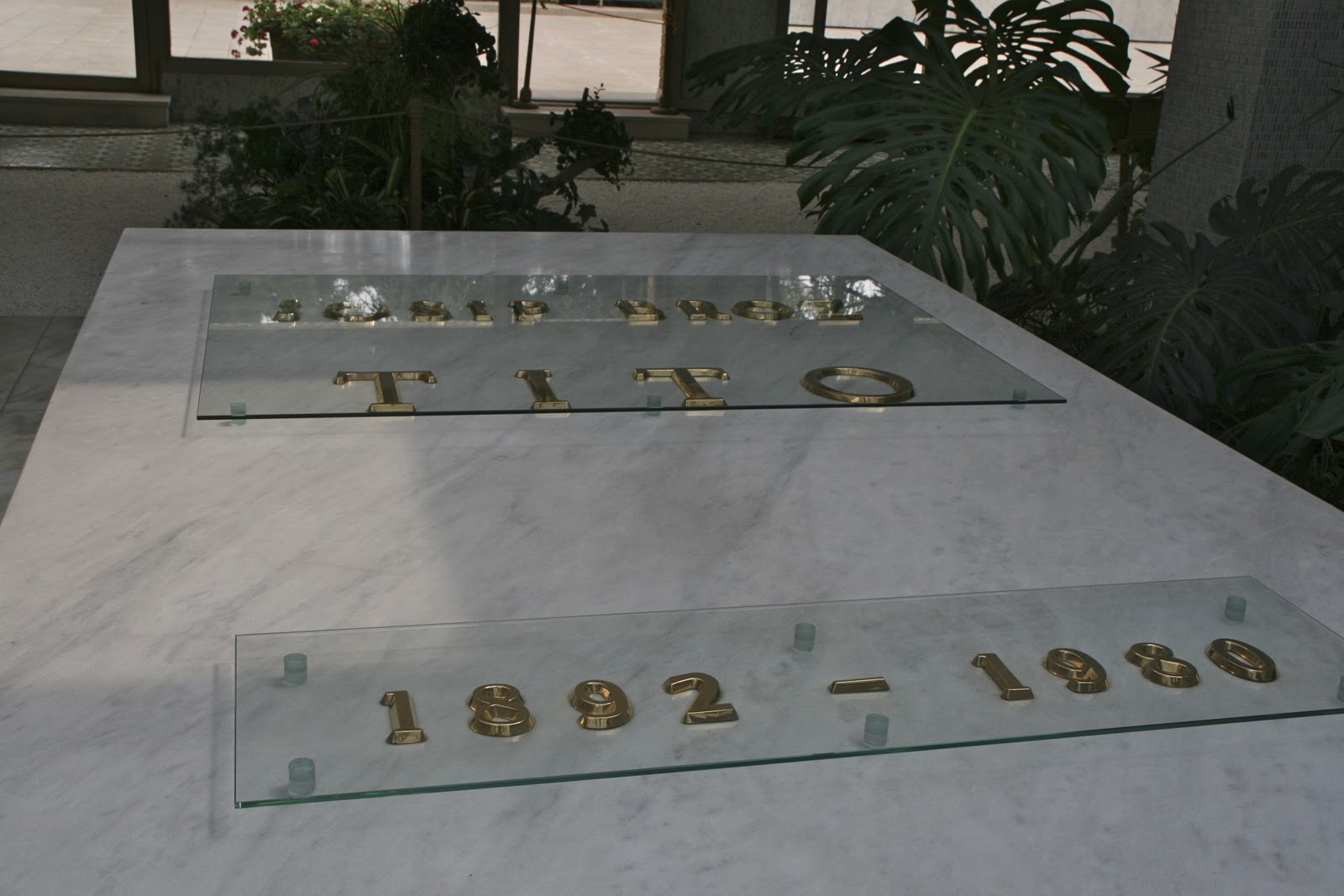
To add to my list of Interesting People to Learn More About: Josip Broz Tito, leader of Yugoslavia in one position or another from 1943-1980. When he passed away on May 4, 1980, just before his 88th birthday, he was serving as the life long President of Yugoslavia.  In one of the largest state funerals in history, 128 countries were represented, including leaders from both Communist and non-Communist countries.  Though born in Croatia under the Austro-Hungarian Empire (see Budapest and Vienna posts), he chose to be buried in his simplistically beautiful winter garden known as The House of Flowers (Kuca Cveda) at his residence in Belgrade.  Most of the surrounding rooms now have memorabilia from his life.  Belgrade was the capital of Yugoslavia as well as  the Republic of Serbia.

When traveling, I like to find out how the people view their leaders and compare it to the impressions I have gained through the filter of my American eyes and ears.  I had viewed Tito as a moderate socialist dictator, but did not appreciate how positively many of the people of the former Yugoslavia look back "to the good times" of his rule.  One guide said he went from a brutal to a benevolent dictator as the years went on.  But was this a genuine transformation or a masterful manipulation or something in between?  With the dissolution of Yugoslavia and the Balkan Wars that followed, I can understand why some would look back fondly on those years.

However one views Tito, he was a remarkable leader.  Captured by the Russians in WWI, he became a Bolshevik and returned to the Balkans as a leader in the Communist movement.  He led the Partisan forces against the conquering Nazis and became viewed as the liberator of Yugoslavia in WWII.  He had a strained relationship with Stalin, and at one time told Stalin to stop sending assassins to kill him or he would send Stalin one that wouldn't miss. He defied the Soviets, established cordial relationships with Western nations, and was one of the founders of the Non-Aligned Movement of nations that would not give allegiance to either side of the Cold War.

Over the years, he allowed more free enterprise, greater religious tolerance, more independence to the republics, and opened his borders to travel both in and out of the country.   For many years, Youth Day was held on his birthday when a relay through the country would bring him a torch.   Parts of many of these torches are displayed at the House of Flowers.

But Tito was not without controversy.  His greatest success in establishing "Brotherhood and Unity" came at the price of nationalist suppression in the tempestuous Balkan area.  (Yugoslavia only became a nation in the peace terms of WWI).  In his personal life, Tito had a series of wives and lovers and at one time had 32 residences.  So, in the end, was he a "dictator" or a popular elected leader?  And how did he unify the Balkan states for nearly 40 years--loyalty, fear,  or something else?

On the grounds of his Belgrade residence is the History of Yugoslavia Museum which contains many of the gifts that were given to Tito.  However, rather than gleaming metals or rare jewels, I was impressed that he seemed to treasure the craftsmanship of  the people.  On display are wonderful costumes of the regions of Yugoslavia, musical instruments, and other handmade items.  And what gifts did Tito give to the people?  Independence from Soviet oppression, relative prosperity, and peace.  Only 11 years after his death, that fragile peace disintegrated into the Balkan Wars (see Vukovar post).

Instead of my traditional slideshow, there is a Flicker group of photos of the costumes (my mother would have loved them).   Sorry for the light reflections.  I didn't have my camera's polaroid filter with me.
Click link for Flicker photos: (New problem to work out:  link will take you to Flicker, but it doesn't bring you back to the blog.  You will have to re-enter the blog site for now)
Gifts to Tito


Coming Post: Viva Viminacium, Serbia
Additional Information:
http://en.wikipedia.org/wiki/Yugoslavia#1918.E2.80.931928
http://en.wikipedia.org/wiki/Josip_Broz_Tito

Saturday, November 13, 2010

Belgrade (Beograd), Serbia

July 2010

When I first looked at my cruise itinerary, I felt curiosity, but also some apprehension, about our journey to Belgrade and through Serbia.  My first minutes driving through Belgrade heightened my concern, as we drove through older, crowded parts of town where tall, crumbling, concrete buildings nearly blocked the sun from the streets.   We passed empty buildings that were bombed in the 1999 NATO attack and the US Embassy with its covered windows.

But I know there are two sides to most cities. My feelings changed when I saw the charming old mosaics from a zoo that opened in 1936 (the original zoo was started in 1730) and  discovered a lovely city of parks, art deco and neo-classical buildings, cafes, stylish shops, and friendly people.   By the end of the day, I found myself comfortably exploring the areas around their famous Knez Mihailova Street and the Republic Square and walking back to the boat on my own.  Serbian uses the Cyrillic alphabet, but a number of signs also use the Roman alphabet--at times even in English which made it easier to get around.  Many people spoke some English, especially those in the shops or selling souvenirs in the middle of the stylish pedestrian streets.
Belgrade is an ancient site. Nearby, there are ruins at Vinca dating from the late-Neolithic period (5500-5000 BC).  They say Belgrade has been conquered and destroyed 44 times, most recently in WWII when the Nazis bombed it to get the city and then by the Allies to get the Nazis out.  It has witnessed 115 battles; had 40 names; and been a capital city 5 times. The Kalemegdan (ruins of a Turkish and later Austrian fortress)  rises above ruins of earlier Roman and medieval fortresses on the bank where the Sava River flows into the Danube.  Today the area is a beautiful park where children play and tourists enjoy vistas over the fortress walls.  We spent a windy, but pleasant, afternoon there.  Across the Sava,  we could see New Belgrade, a newly developed area of modern buildings and exclusive hotels.

In the area of the Patriachate  (home of Patriarch of the Serbian Orthodox Church) is the neoclassical Saborna Church (1836)  with its gilded mosaics and, nearby, is the graceful residence (1831) of the  Princess Ljubica.  They say that the palace of the princess was more beautiful than that of her husband, the prince, although they were designed by the same architect (I wonder if that created any family issues).

Nearby is also an interesting Balkan-style cafe named "At the Question Mark" with a ? as  it's sign.  It is the oldest restaurant in Belgrade (1823).  In 1892, when it's new owners wanted to name it "At the Cathedral Church" due to its proximity to the church on St. Peter's Street,  both the church and authorities objected--it didn't meet the restaurant standards and I guess the Church didn't want to be associated with the first place in town to have a billiard table.  So the owner just put a ? on the sign, and it has been a popular eating place ever since.

I had come to Belgrade looking for a sun hat, as I had forgotten to pack mine, but had not found one as I headed back to the boat.  Then, I spotted a straw hat on the docks where a group of ladies were selling their hand embroidered and crocheted wares.  As we could not speak each other's language,  we bargained with gestures and nods, and I ended up with a "good deal" on the hat as well as a crocheted shawl with a couple of embroidered doilies because I didn't have the right change.  Whatever I paid, it was worth the experience, and I left Belgrade not only with a new hat, but also a new friend.

Click link for slideshow:
Belgrade, Serbia

Music: Ansambl Triola, Da smo se ranije sreli , Kolekcja pesama 2009 (Once again I don't know what the song means, but I enjoyed the Serbian group that performed it on the riverboat)


More information:  http://www.beograd.rs/cms/view.php?id=220 http://www.belgradenet.com/question_mark.html

Monday, November 1, 2010

"Take me home" to Osijek and Aljmas, Croatia

July 2010

Not many miles from Vukovar, we visited Osijek, the fourth largest city in Croatia and a district capital  in eastern Croatia known as Slovania (not to be confused with the countries Slovenia or Slovakia).  After the fall of Vukovar in the Balkan Wars, Osijek and the surrounding towns were taken by the Serbs, but were not as heavily damaged.  (see Vukovar post)  Like other cities on the Danube, Osijek has been under the Romans, Magyars (Hungarians), Turks, Austrians, Germans--to name a few.  We walked around the old fort along the Drava River (which empties into the Danube) and into the Old Town area with its pleasant square and grand old houses.  Osijek today is both an industrial city and a lively university town.

On the outskirts, we had midday entertainment by the Croatia Tambura Band who not only shared lively Croatian tunes, but also reminded us of home with Old Susanna, Rolling Down the River, and Take Me Home Country Roads (John Denver).  I certainly hadn't expected to be singing about going home to West Virginia in Croatia, but coming home is a relevant theme for the area.


One of the most meaningful parts of my entire trip was our lunch in the town of Aljmas.  We were divided into groups of eight to be hosted by Croatian families who had experienced the Balkan
Wars and were willing to share their food and stories.  I went to the home of Maria and Ivan who run a bed and breakfast.  As their English was limited, their young adult niece, Martina, translated for us.  Martina is a physics teacher at a secondary school in a nearby town.  Aljmas is located at a beautiful stretch of the Danube where fishermen and families come to enjoy a few days on the river.  As we walked to their home, I was impressed by the lovely gardens and homes in this area.

Maria was a wonderful cook, and we enjoyed roasted chicken with fresh-from-the-garden vegetables and a delicious ground nut and custard dessert.  Ivan had made his own maraskino, a  cherry liqueur  that is a speciality in the area.  I had instead a wonderful fresh visne, a sour cherry non-alchoholic drink also made by Ivan. (I loved it in Turkey as well.)

Then, at the request of the guests, Martina shared their story.  They were living in Aljmas when Vukovar
fell, and, when the Serbs were at the outskirts of town, they had to escape at night by the Danube with a few possessions they bundled together.  Martina's family also lived in the town, so the families went together.  They expected that they would be back in a couple of days or weeks.  Around this time Ivan had a stroke and needed hospitalization in Osijek, but when that city was also attacked, they were sent to a hospital in Zagreb, the capital.  A doctor there had compassion on them and allowed the families to stay in her country home outside the city.  With great insight, Martina shared that during the next seven years, they were able to find happiness in the midst of their unhappiness.

When they returned in 1998, their home was still standing, but everything in it had been taken--the furniture, the family photos, the heirlooms.  Like the other homes in the community, it had been taken and lived in by others.  But their family was grateful to be home together.  The beloved old town church was destroyed, but Maria noted that a church is more than a building-- it is the people who worship together.  The church has now been rebuilt in a modern style which does not please many in the town.  I was impressed that they could tell us their story without bitterness and were able to recognize those things of greatest value.  As Martina said, "You just have to move on."  Martina is engaged, and she and her fiance plan to build a house in Aljmas.  And so life does move on to another generation.  Thank you, Ivan, Maria, and Martina for not only sharing your home, but your hearts.

Click link for slideshow:  
Osijek and Aljmas
Music:  Track 7 from CD of Croatia Tambura Band:  I don't have the name of the tracks and don't know what the song is about.  I hope it is a happy and good song.
More Information:  http://en.wikipedia.org/wiki/Osijek